
Draw Near
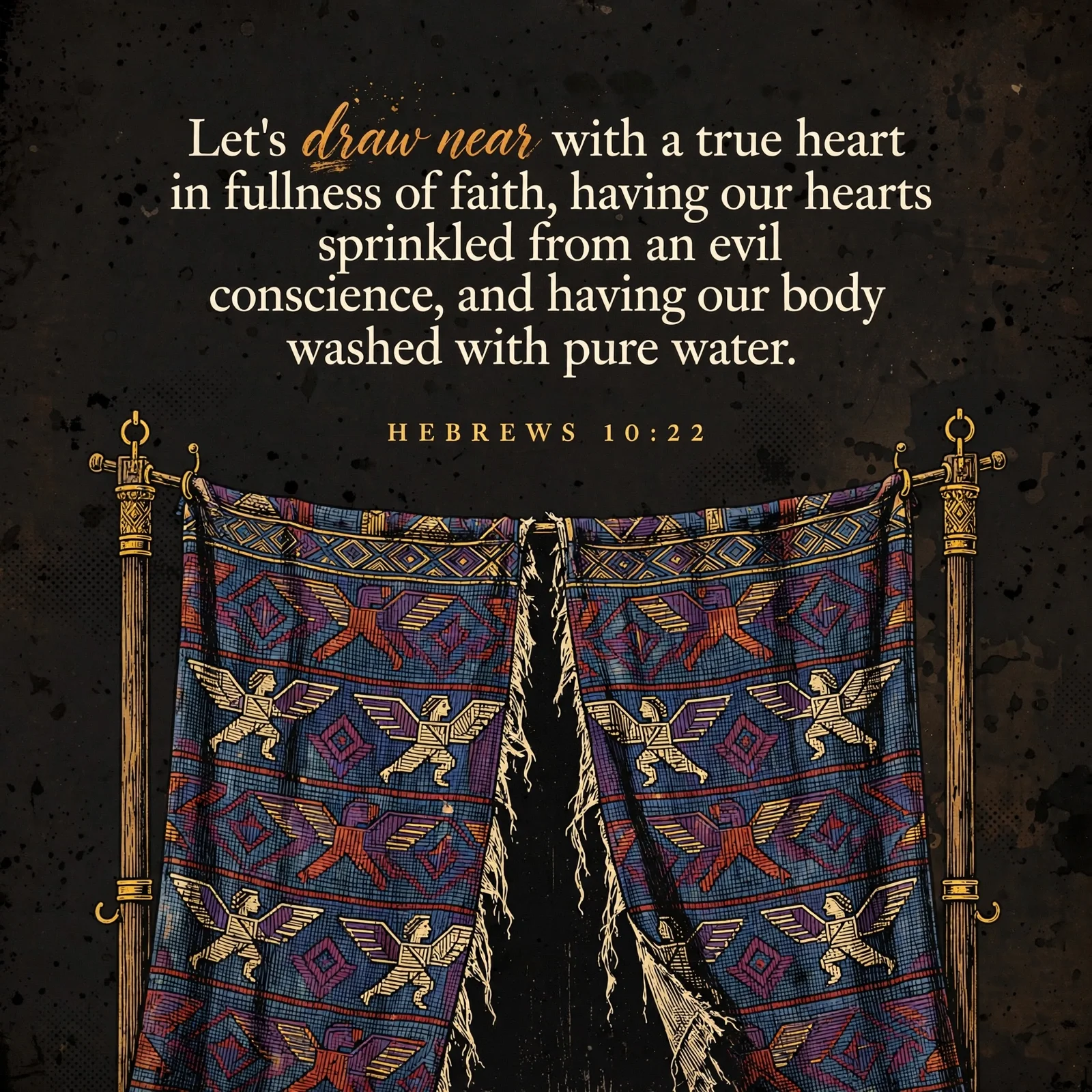
Hebrews 10:22 invites us to draw near to God with confidence because Jesus has cleansed us and opened the way into God’s manifest presence.
“Let’s draw near with a true heart in fullness of faith, having our hearts sprinkled from an evil conscience, and having our body washed with pure water.” - Hebrews 10:22
In the Old Testament, only the high priest could enter the Holy of Holies, where God’s presence dwelt—and only once a year, on the Day of Atonement. He washed his body and brought sacrificial blood for his own sins and those of the people. Everyone else remained outside the curtain. The curtain was a massive woven veil—blue, purple, and scarlet yarn embroidered with cherubim—that hung between the Holy Place and the Most Holy Place. It was the boundary line: on one side the priests went about their daily work; on the other, God’s manifest presence rested above the ark. No one crossed it except the high priest, and only then.
Through his own atoning sacrifice, Jesus has opened the way for all who belong to him to enter God’s presence. Hebrews 10:19–21 establishes the foundation for this invitation: we have confidence to enter God’s presence through Jesus’ blood, and we have a great priest over God’s house. That gives us two unshakable grounds for coming. First, the way is open—Jesus’ blood has consecrated a new and living way through the curtain, which is his flesh. Second, the priest is ours—not a man who must first offer for his own sins, but the Son who has passed through the heavens and sat down at God’s right hand. We do not approach on the strength of our record. We approach on the strength of his. What was reserved for one priest on one day of the year is now the privilege of every believer: to draw near to God.
“Let us draw near”
This is an invitation to approach God himself—to bring him our worship, prayers, confession, and needs. Jesus’ sacrifice brings us into fellowship with the God whose holiness once required the curtain to stand between his people and the innermost sanctuary. The curtain was necessary because God’s holiness is lethal to sin. At Sinai the people begged, “Don’t let God speak with us, lest we die.” Isaiah saw the Lord and cried, “Woe is me.” When the glory filled Solomon’s temple, the priests could not stand to minister. The curtain was not cruelty; it was mercy—a barrier shielding guilty people from unshielded glory. It is not necessary now because the problem it guarded has been dealt with at the root: Christ’s sacrifice has cleansed our sin itself. The danger is gone, so the barrier came down—torn from top to bottom at his death, by God’s own hand.
And the invitation is communal: let us. Together, we are a people welcomed into God’s presence through Jesus’ sacrifice.
“With a true heart”
A true heart is sincere before God. We come without pretending, concealing our sin, or performing a religious devotion while withholding ourselves from him. We bring our actual lives: what we love, what we fear, where we have failed, and where we need his help.
This sincerity includes a wholehearted desire to belong to him. We approach honestly, ready to trust and obey the God who welcomes us.
“In fullness of faith”
We draw near trusting that Jesus’ sacrifice is sufficient for us. Earlier in the chapter, Hebrews explains that repeated animal sacrifices could never fully remove our sin. Jesus offered himself once for all.
Our confidence rests on the finished work of Christ. When our conscience accuses us, we can confess our sin and trust the cleansing he provides. We do not have to achieve a certain feeling of worthiness before approaching him. Jesus is the reason we can come.
“Having our hearts sprinkled from an evil conscience”
This draws on the sprinkling of sacrificial blood to cleanse and consecrate people for God. Here, that cleansing reaches the heart and conscience.
Hebrews 9:14 explains that Christ’s blood cleanses our conscience from dead works so that we can serve the living God. His sacrifice addresses the guilt that leaves us ashamed and afraid to approach. Forgiveness frees us to stand before God and offer ourselves in his service.
“Having our body washed with pure water”
This recalls the washing of priests before sacred service and likely also points to Christian baptism. Together, the sprinkled heart and washed body describe people cleansed and set apart for God, inwardly and outwardly.
The language also recalls the prophetic promise of Ezekiel 36:25–27. God promises to sprinkle clean water on his people, cleansing them from their impurities and idols. He promises to remove their hearts of stone and give them hearts responsive to him. Then he declares, “I will put my Spirit within you,” enabling them to walk in his ways.
The God whose presence was behind the curtain now puts his Spirit within his people. He cleanses us, changes our hearts, and enables us to live in fellowship with him.
Notice the order of Hebrews 10:22: having been cleansed, let us draw near. God’s gracious action makes our response possible. We approach with sincerity because we no longer need to hide, with confidence because Jesus has atoned for our sin, and with our whole lives because we have been set apart to belong to God.
Father, I come to you through Jesus, whose blood has opened the way. Give me a true heart and full assurance that his sacrifice is enough. Cleanse my conscience, and teach me to draw near with confidence. Amen.
